- Neural Pulse
- Posts
- NVIDIA Debuts Nemotron 3 Family of Open Models
NVIDIA Debuts Nemotron 3 Family of Open Models
NVIDIA has unveiled the Nemotron 3 family of open models(Nano, Super, and Ultra) designed to enhance agentic AI applications...

Andres Vourakis
December 16, 2025

Hey there 👋
We hope you're excited to discover what's new and trending in AI, ML, and data science this week.
Here is your 5-minute pulse...
print("News & Trends")NVIDIA Debuts Nemotron 3 Family of Open Models (6 min. read)

Image source: NVIDIA
NVIDIA has unveiled the Nemotron 3 family of open models (Nano, Super, and Ultra) designed to enhance agentic AI applications. These models introduce a hybrid mixture-of-experts architecture, boosting throughput and accuracy. The Nano model, for instance, delivers four times the throughput of its predecessor, making it ideal for scalable multi-agent systems. Early adopters like Accenture and ServiceNow are integrating Nemotron 3 to power AI workflows across various industries.
NeuralOperator Joins the PyTorch Ecosystem: Learning in Infinite Dimension with Neural Operators (3 min. read)
Image source: Pytorch
NeuralOperator, an open-source Python library developed by NVIDIA and Caltech, has joined the PyTorch Ecosystem, offering a robust framework for learning mappings between function spaces. This integration empowers researchers to efficiently solve complex problems like partial differential equations by training models that generalize across varying discretizations. With access to state-of-the-art architectures such as Fourier Neural Operators, users can accelerate PDE solvers and seamlessly incorporate physics-informed losses into their workflows.
Image source: Google
Google's latest enhancements to the Gemini 2.5 Flash Native Audio model are set to revolutionize voice interactions. The model now boasts sharper function calling, robust instruction adherence, and smoother multi-turn conversations, making AI-driven dialogues more natural and efficient. Additionally, the introduction of live speech translation preserves speaker intonation and pitch, facilitating real-time, nuanced communication across languages. These advancements are now accessible through platforms like Google AI Studio and Vertex AI, empowering developers to craft more engaging and responsive voice applications.
AI Data Scientist Handbook (5 min. read)
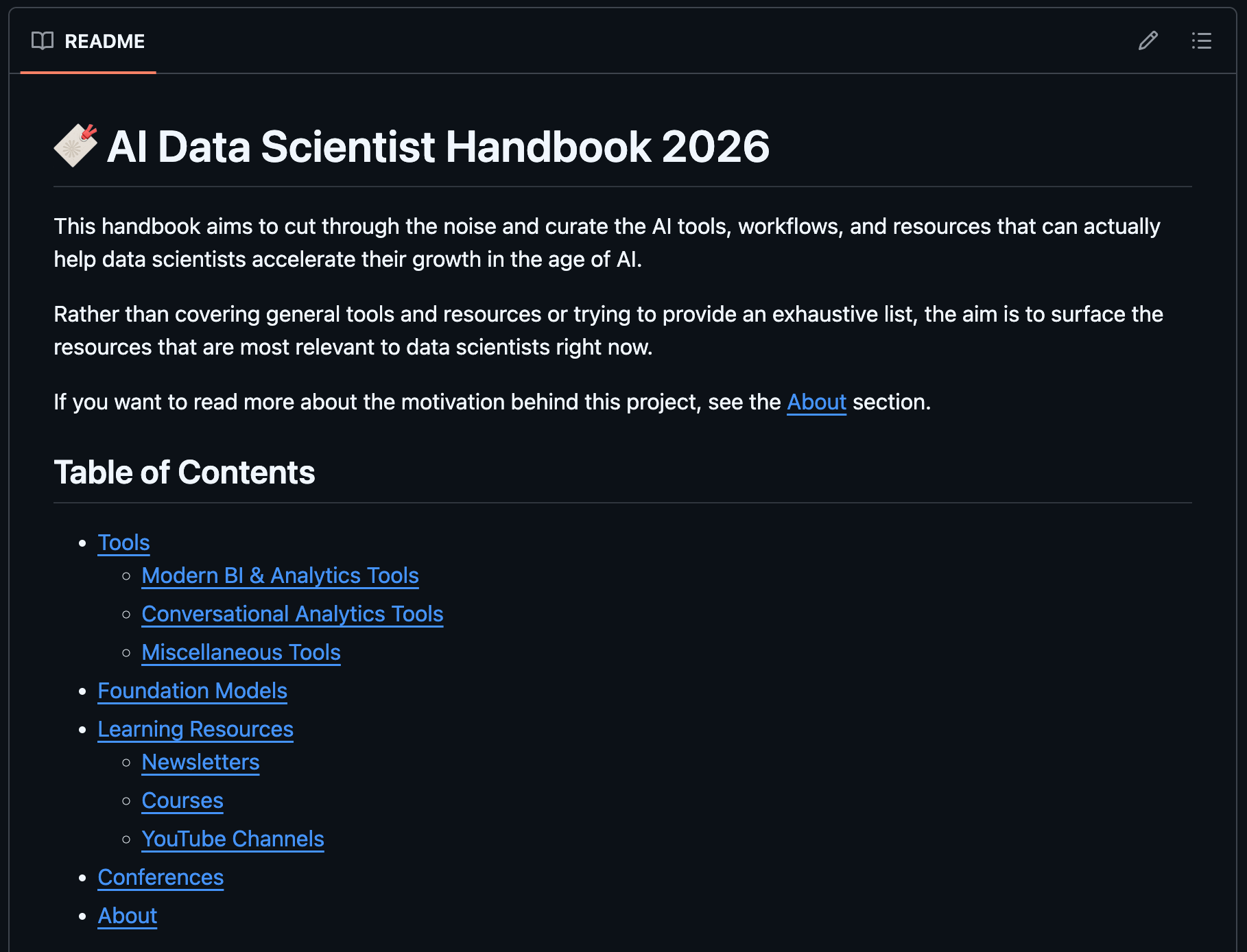
Image Source: Andres Vourakis
This handbook curates a comprehensive list of AI-native tools, workflows, and resources designed to help data scientists accelerate their careers in the age of AI. It offers insights into cutting-edge technologies and methodologies, providing a valuable guide for both aspiring and experienced professionals aiming to stay ahead in the rapidly evolving field of data science.
Image source: Google
Google has unveiled the Interactions API, a streamlined interface for developers to engage with Gemini models and agents. This API simplifies the creation of complex agentic applications by managing intricate interactions, including server-side state and background execution. Notably, it introduces the Gemini Deep Research agent, capable of executing extensive research tasks and synthesizing comprehensive reports. Currently in public beta, the Interactions API is accessible through the Gemini API in Google AI Studio.
print("Applications & Insights")Dashboards Were Never the Destination (5 min. read)
Dashboards have long been the hallmark of a "data-driven" company, but they've often fallen short of driving real decisions. They highlight what happened but rarely explain why, leading to more questions than answers. The future lies in agentic analytics systems that not only present data but also provide context and reasoning, enabling deeper insights and more informed decisions.
How to Measure Similarity Between SQL Queries Using Embeddings (6 min. read)
Lucas de Brito Silva explores transforming SQL queries into vector embeddings to analyze user interactions with data lakes. By converting queries into numerical vectors using sentence-level embeddings, data engineers can measure query similarity, cluster related queries, and detect anomalies. The article provides a practical guide, including environment setup and code examples, to implement this approach effectively.
Codex is Open Sourcing AI Models (12 min. read)
Hugging Face has integrated its 'Skills' repository with OpenAI's Codex, enabling coding agents to autonomously handle tasks like fine-tuning language models, monitoring training metrics, and deploying models. By issuing simple commands, Codex validates datasets, selects hardware, updates training scripts, and manages the entire training lifecycle, culminating in a ready-to-use model on the Hugging Face Hub. This advancement streamlines complex ML workflows, making them more accessible and efficient.
print("Tools & Resources")TRENDING MODELS
Text-to-Image
Tongyi-MAI/Z-Image-Turbo
⇧ 297K Downloads
A state-of-the-art text-to-image model capable of generating high-quality images from textual descriptions. It offers rapid inference times and supports a wide range of styles and subjects.
mistralai/Devstral-Small-2-24B-Instruct-2512
⇧ 28K Downloads
A 24-billion parameter language model fine-tuned for instruction-following tasks. It excels in generating coherent and contextually relevant responses across diverse prompts.
Text-to-Speech
microsoft/VibeVoice-Realtime-0.5B
⇧ 159K Downloads
A 0.5-billion parameter model designed for real-time text-to-speech applications. It produces natural-sounding speech with low latency, suitable for interactive voice systems.
Image-Text-to-Text
zai-org/GLM-4.6V-Flash
⇧ 102K Downloads
An advanced model that interprets images and generates descriptive text, enhancing image understanding tasks. It supports multiple languages and offers fast processing capabilities.
Image-Text-to-Text
zai-org/AutoGLM-Phone-9B
⇧ 52K Downloads
A 9-billion parameter model optimized for generating textual descriptions from images, particularly in mobile applications. It balances performance and efficiency for on-device processing.
TRENDING AI TOOLS
🧮 Quadratic: Collaborative spreadsheet tool for data scientists and engineers.
🤖 Zerve: AI-driven development environment for data science, enabling rapid insights, apps, and APIs through chat or code.
🚀 Google Antigravity: An agent-first AI development environment for orchestrating autonomous coding tasks
📝 Code Wiki: Collaborative platform for sharing and documenting code snippets and best practices.
print("Everything else")Google introduces the Gemini API to enhance AI-driven research capabilities for developers and researchers.
Thinking Machines announces general availability of Tinker, a platform for fine-tuning and serving large language models.
Voxel51 introduces sample-level debugging to enhance MLOps pipelines by identifying and resolving data issues at a granular level.
A recent Harvard study analyzes the adoption and usage patterns of AI agents in web environments, highlighting significant variations across user demographics and sectors.
That’s it for today!
Before you go we’d love to know what you thought of today's newsletter to help us improve the pulse experience for you.
See you soon,
Andres