- Neural Pulse
- Posts
- Ilya Sutskever Says We're Moving from the Age of Scaling to the Age of Research
Ilya Sutskever Says We're Moving from the Age of Scaling to the Age of Research
In this insightful conversation, Ilya Sutskever, OpenAI's Chief Scientist, discusses the transition from scaling AI models...

Andres Vourakis
November 27, 2025
In partnership with


Hey there 👋
We hope you're excited to discover what's new and trending in AI, ML, and data science this week.
Here is your 5-minute pulse...
But first, a quick message from our partner 👇
The best way to future-proof your Data Science career

This bootcamp helps data scientists master AI workflows and automation so they can stay relevant, work smarter, and accelerate career growth.
Over 6 weeks, you’ll:
Go beyond just prompting ChatGPT
Build real AI workflows week-by-week that save hours
End with your own Slackbot that talks to your data
📌 Enrollment for the upcoming cohort is now open
print("News & Trends")Anthropic Introduces Claude Opus 4.5 (2 min. read)
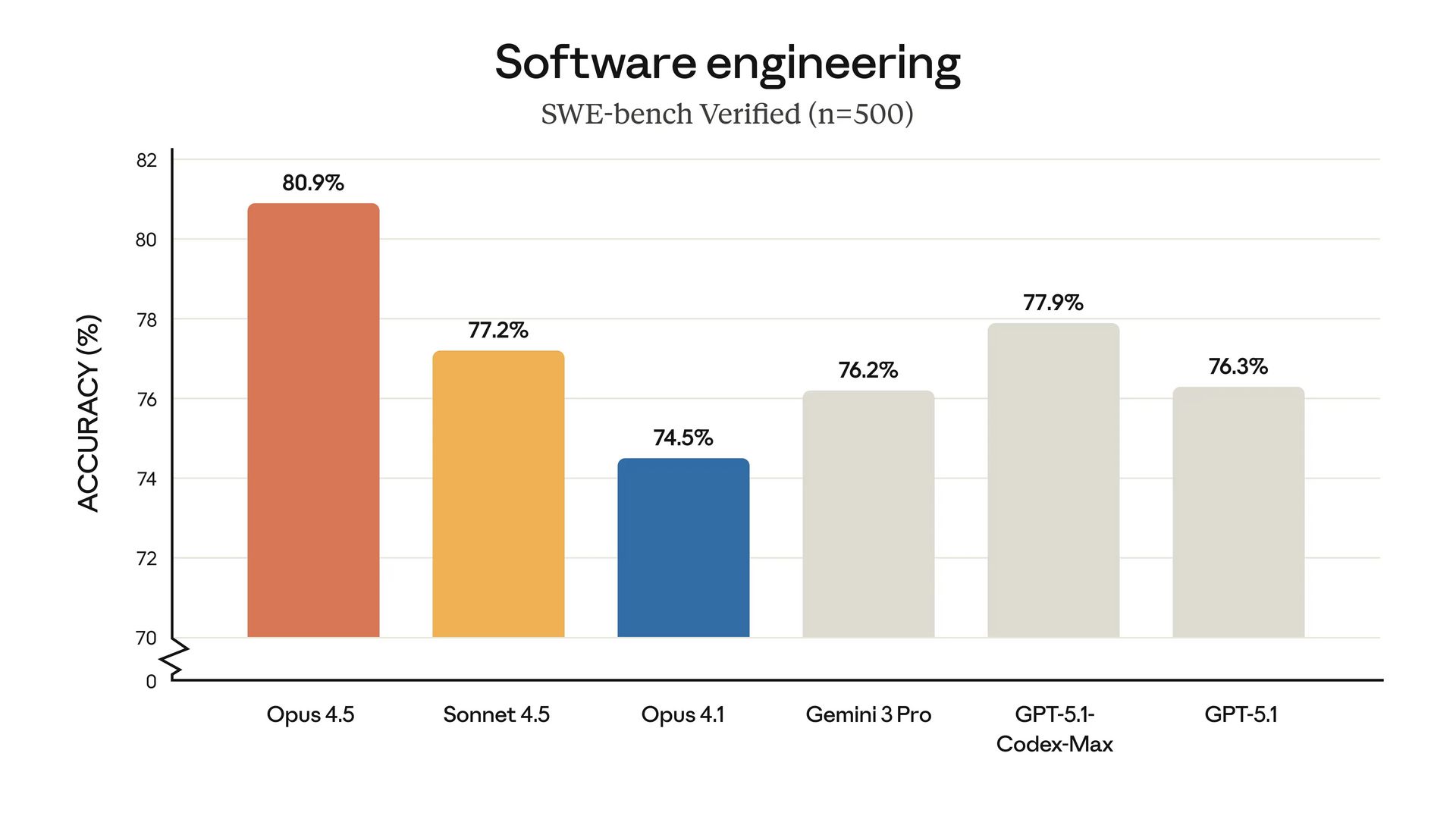
Image source: Anthropic
Anthropic's latest release, Claude Opus 4.5, sets a new standard in AI for coding, agents, and computer use. It excels in real-world software engineering tasks, achieving top scores on SWE-bench Verified. Now available across multiple platforms, Opus 4.5 offers enhanced performance at a more accessible price point, making advanced AI capabilities more attainable for developers and enterprises alike.

Image source: Dwarkesh Podcast
In this insightful conversation, Ilya Sutskever, OpenAI's Chief Scientist, discusses the transition from scaling AI models to focusing on research-driven improvements. He delves into the challenges of model generalization, the limitations of pre-training, and strategies for aligning artificial general intelligence (AGI) with human values. Sutskever emphasizes the need for innovative research to enhance AI capabilities beyond mere scaling, highlighting the importance of understanding and improving how models learn and generalize.

Image source: Stanford
Stanford's Machine Learning Group introduces the Agentic Reviewer, an AI-driven tool offering detailed feedback on research papers. By uploading a PDF, authors receive comprehensive reviews tailored to their target venues, enhancing the quality and relevance of their submissions. This free service aims to streamline the revision process, providing constructive insights to researchers seeking to refine their work.
print("Applications & Insights")Early Experiments in Accelerating Science with GPT-5 (8 min. read)
OpenAI's latest paper showcases GPT-5's transformative role in scientific research, highlighting collaborations where the model rapidly identified immune cell mechanisms, contributed to solving longstanding mathematical problems, and enhanced optimization methods. These case studies demonstrate GPT-5's potential to accelerate discovery across disciplines, offering a glimpse into a future where AI serves as a dynamic partner in scientific innovation.
Universal LLM Memory Does Not Exist (5 min. read)
In this insightful piece, the author benchmarks Mem0 and Zep using MemBench to uncover why production agents falter. Surprisingly, these memory systems are 14-77 times more expensive and 31-33% less accurate than simple long-context approaches. The culprit? An "LLM-on-Write" architecture that triggers multiple background LLM processes per interaction, leading to significant latency and cost increases. This deep dive challenges the efficacy of current LLM memory systems in real-world applications.
Estimating AI Productivity Gains (4 min. read)
Anthropic's latest research delves into real-world interactions with their AI assistant, Claude, revealing that AI can slash task completion times by an average of 80%. Analyzing 100,000 anonymized conversations, they found tasks typically taking 1.4 hours without AI assistance were significantly expedited. Extrapolating these findings, the study suggests that current AI models could potentially double the annual U.S. labor productivity growth over the next decade. However, the research acknowledges limitations, such as the need for human validation of AI outputs, indicating that while the potential is vast, real-world applications may vary.
Semantic Layers and the Future of Agentic Analytics (6 min. read)
The article delves into how semantic layers are revolutionizing agentic analytics by providing a unified, context-rich framework that enhances data interpretation and decision-making. It explores the integration of these layers with machine learning models, emphasizing their role in improving model accuracy and interpretability. The piece also discusses the challenges of implementing semantic layers, such as scalability and maintaining data consistency, while highlighting their potential to transform analytics into more autonomous and insightful processes.
Air Canada Lost a Lawsuit Because Their RAG Hallucinated. Yours Will Too (6 min. read)
Air Canada's chatbot misled a passenger about bereavement fares, leading to a lawsuit the airline lost. This incident underscores the dangers of AI hallucinations in Retrieval-Augmented Generation (RAG) systems. Traditional detection tools, like RAGAS and DeepEval, often fail to catch these errors, as they focus on known uncertainties. Cleanlab's benchmarks reveal that the Trustworthy Language Model (TLM) outperforms others by addressing both known and unknown uncertainties, offering a more reliable solution for detecting hallucinations in AI systems.
Foundation Model for Personalized Recommendation (11 min. read)
Netflix unveils a foundation model for personalized recommendations, centralizing user preference learning to streamline system maintenance and innovation transfer. Inspired by large language models, this approach leverages extensive user interaction data, employing techniques like sparse attention and sliding window sampling to manage long-term preferences efficiently. The model addresses challenges such as cold-start scenarios by integrating metadata-based embeddings, ensuring adaptability to new content, and enhancing recommendation quality across diverse applications.
print("Tools & Resources")TRENDING MODELS
text-to-video
tencent/HunyuanVideo-1.5
⇧ 2K Downloads
HunyuanVideo-1.5 is a text-to-video model developed by Tencent, enabling users to generate videos from textual descriptions. It offers high-quality video synthesis, making it suitable for various multimedia applications.
mask generation
facebook/sam3
⇧ 181K Downloads
SAM3 is a mask generation model by Facebook, designed to produce accurate segmentation masks for images. It enhances image analysis tasks by providing precise object delineation.
image-to-image
black-forest-labs/FLUX.2-dev
⇧ 115K Downloads
FLUX.2-dev is an image-to-image transformation model from Black Forest Labs, facilitating advanced image editing and style transfer. It allows for creative modifications and enhancements of input images.
image-text-to-text
tencent/HunyuanOCR
⇧ 24K Downloads
HunyuanOCR by Tencent is an optical character recognition model that converts images containing text into editable text formats. It supports multiple languages and is optimized for high accuracy in text extraction.
text-to-image
Tongyi-MAI/Z-Image-Turbo
⇧ 2K Downloads
Z-Image-Turbo is a text-to-image model developed by Tongyi-MAI, capable of generating detailed images from textual prompts. It is designed for rapid image synthesis with high fidelity to the input descriptions.
TRENDING AI TOOLS
🔍 Edison Analysis: Advanced data analytics platform for scientific research and discovery.
🔍 HunyuanOCR: Accurate and efficient optical character recognition for various languages and scripts.
🤖 Annie: AI-powered business intelligence agent for data-driven insights.
print("Everything else")Amazon announces a strategic AI investment to support U.S. federal agencies in their digital transformation efforts.
Exa has released version 2.1, enhancing search API performance for both low-latency and agentic searches.
Tracking AI monitors AI chatbot political biases by analyzing their responses to standardized tests.
Google's Antigravity tool reportedly exfiltrates data, raising concerns about data privacy and security. Google introduces
Gemini interactive images to enhance learning experiences with AI-powered visual content.
That’s it for today!
Before you go, we’d love to know what you thought of today's newsletter to help us improve the pulse experience for you.
See you soon,
Andres